
Beef sticks and beef jerky are both portable, protein-rich meat snacks, but they aren’t exactly the same. They differ in how they are made, but the texture, fat and sugar content, and ingredients may also vary.
Traditionally, beef sticks (vs beef jerky) are made from ground, seasoned beef stuffed into a casing and cooked or fermented. Meanwhile, classic beef jerky is made by slicing, seasoning, and drying whole strips of beef. However, jerky can also be made from chopped or ground-and-formed meat.
Beef sticks are often softer and can be higher in fat. Beef jerky is chewier, higher in protein per calorie, and sometimes contains added sugar.
So, are beef jerky or beef sticks the better snack? Here’s how they compare.
Key Takeaways
Beef sticks vs beef jerky refers to the comparison between two distinct types of dried meat snacks that differ in preparation, texture, and nutritional profile. Beef sticks are made from ground, seasoned beef stuffed into a casing and cooked or fermented. Beef jerky, on the other hand, is made from whole-muscle strips of beef that are marinated and dehydrated.
-
Beef sticks are typically softer and higher in fat, while beef jerky is chewier and higher in protein per calorie.
-
Many beef jerky products contain added sugar in their marinades, while high-quality beef sticks often contain 0g of added sugar.
-
Both snacks are technically classified as processed meat, but ingredient quality varies significantly by brand.
-
Beef sticks tend to suit keto, Whole30, and Paleo diets, while beef jerky is often preferred by those tracking macros with a strict fat cap.
-
Brand quality matters more than format: a high-quality beef stick can outperform a low-quality jerky on nearly every metric except fat content.
Whether beef jerky or beef sticks is the better choice depends on your nutrition goals, ingredient priorities, and taste preferences. For those who want a beef stick with 0g of added sugar and a clean ingredient list, Chomps has grass-fed and grass-finished beef sticks you can try.
What's the Difference Between Beef Sticks and Beef Jerky?
The biggest difference between beef sticks and beef jerky is generally how the meat is prepared. Beef sticks (vs beef jerky) are typically made from ground meat formed into a cylindrical shape, while traditional jerky is made from strips or pieces of meat that are dried to remove moisture.
What Is a Beef Stick?
Beef sticks (vs beef jerky) is a snack sausage made from ground beef, seasoned, stuffed into a casing (edible or inedible). It’s then cooked, smoked, fermented, dried, or processed using a combination of these methods.
Common characteristics of beef sticks include:
-
Ground meat (not whole muscle)
-
Cylindrical shape, encased
-
If fermented, this gives it a slightly tangy flavor
-
Slow-cooked at low temperatures
-
Softer, chewier texture
-
Higher fat content (fat is intentionally included for flavor and moisture)
-
Typically 80–120 calories per stick, depending on the brand
-
Shelf-stable without refrigeration once sealed
The exact ingredients and processing methods vary by brand.
What Is Beef Jerky?
Beef jerky (vs beef sticks) is beef that has been seasoned and dried to significantly reduce its moisture content. Traditional jerky is generally made from strips of whole-muscle beef, although the USDA also recognizes products made from ground, chopped, or formed beef.
Jerky commonly has:
-
Whole-muscle beef (not ground)
-
Flat strips
-
Marinated, often in soy sauce, sugar, and spices
-
Dehydrated, not cooked in the traditional sense
-
Tougher, chewier texture
-
Lower fat content
-
Typically 70–100 calories per serving
-
Shelf-stable once dried
Because beef jerky (vs beef sticks) is dried extensively, it typically has a denser, more fibrous chew than a beef stick.
Beef Sticks vs Beef Jerky: A Full Comparison
Both offer high protein and portability, but the difference between beef sticks and beef jerky is meaningful in regards to texture, ingredients, sugar content, and nutritional profile.
|
Attribute |
Beef Jerky |
Beef Sticks |
|
Meat form |
Whole-muscle strips |
Ground beef in a casing |
|
Processing method |
Marinated + dehydrated |
Fermented + slow-cooked |
|
Texture |
Tough, chewy, fibrous |
Softer, chewy, sausage-like |
|
Typical protein |
9–12 g per oz |
6–12 g per stick |
|
Typical calories |
70–100 per oz |
80–120 per stick |
|
Typical fat |
1–3 g per oz |
6–10 g per stick |
|
Typical sugar (industry avg) |
3–6 g per oz |
0–2 g per stick |
|
Typical sodium |
300–500 mg per oz |
250–400 mg per stick |
|
Common additives |
Soy sauce, sugar, sodium nitrite |
Varies widely |
|
Shelf stability |
Yes, sealed |
Yes, sealed |
|
Best for |
Long-lasting chew, low-fat diets |
Grab-and-go, kids, low-sugar diets |
Traditional lean beef jerky often provides more protein relative to its calories because much of the fat has been trimmed away. Beef sticks may contain more fat, which contributes to their softer texture, richer flavor, and calorie content.
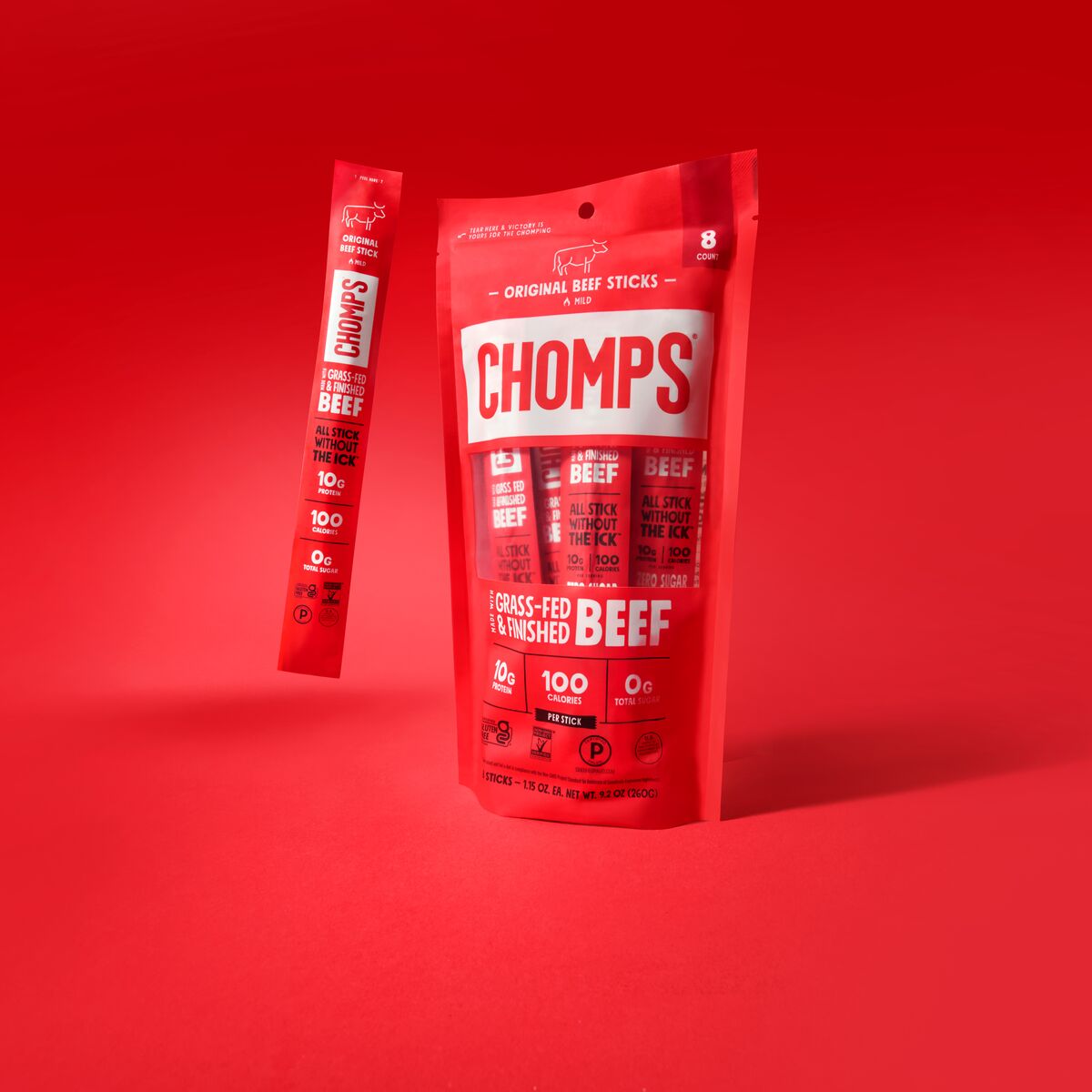
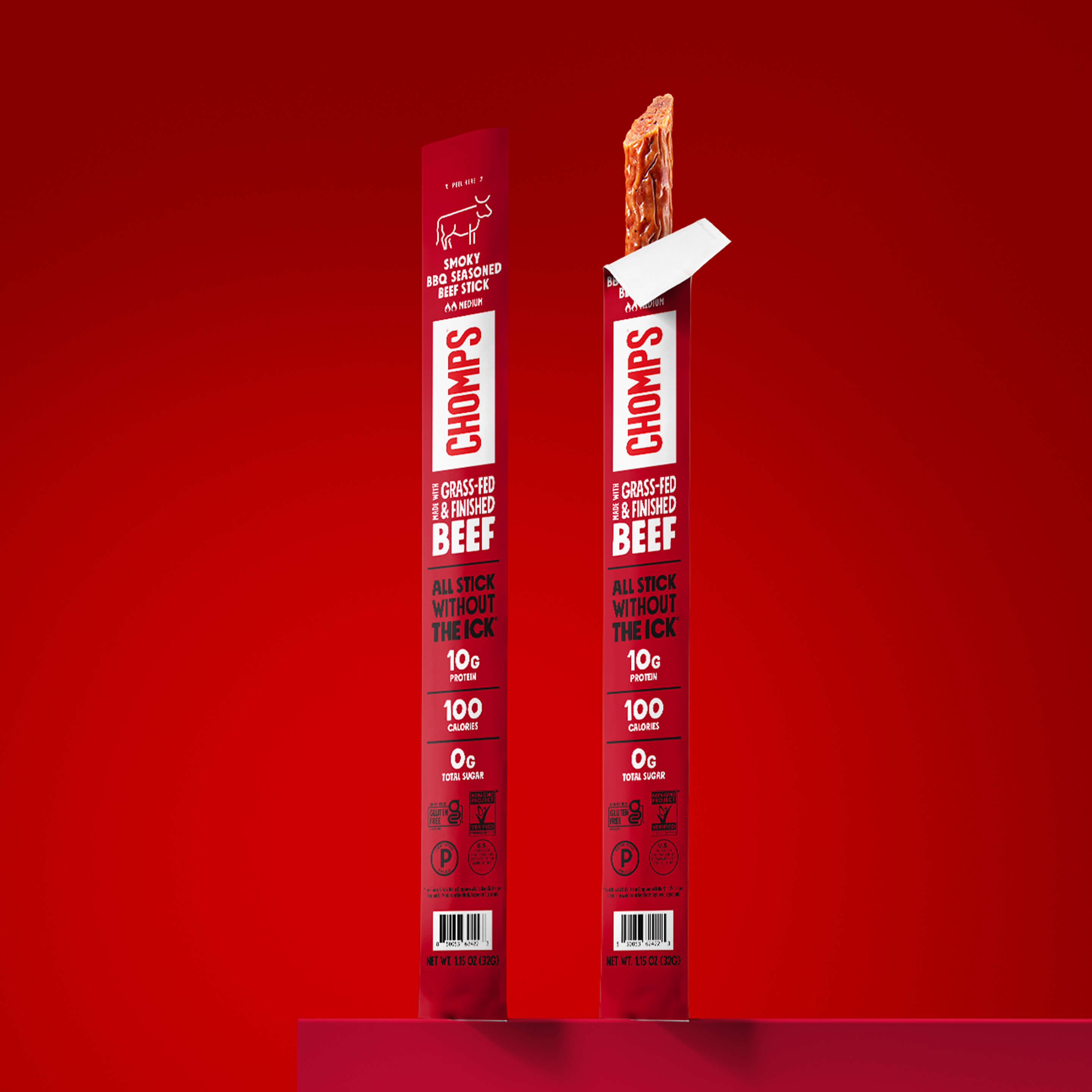
Sugar is another area where the difference between beef sticks and beef jerky is apparent. Many jerky products use sweeteners in their marinades, while some beef sticks are made without added sugar. Chomps Original Beef, for example, contains 10 grams of protein, 100 calories, and 0 g of sugar per stick.
Ultimately, the nutrition label and ingredient list tell you more than the words “beef jerky” or “beef sticks” alone.
Are Beef Sticks Healthier Than Beef Jerky?
Beef sticks can be a better choice than beef jerky for some people, while jerky may fit other nutrition goals better. High-quality beef sticks contain 0g added sugar, no synthetic nitrates, and thoughtful ingredients while most beef jerky often contain added sugar and soy sauce. However, beef jerky is generally lower in fat and calories per gram of protein.
When Beef Sticks Are the Healthier Choice
Consider a beef stick when you:
-
Want an option without added sugar
-
Avoid soy or gluten and have found a product that meets those needs
-
Prefer a short, simple ingredient list
-
Want a softer texture that's easy to eat
-
Need a convenient snack for work, travel, or school lunches
For example, Chomps beef sticks are made with grass-fed and grass-finished beef, are Certified Gluten Free, and have 0 grams of sugar.
When Beef Jerky Is the Healthier Choice
Jerky may make more sense when you:
-
Want more protein relative to calories
-
Prefer a leaner meat snack
-
Are limiting your total fat intake
-
Like the firm, traditional jerky texture
The Real Answer: Brand Matters More Than Format
There isn't one universal winner in the battle between beef jerky vs beef sticks.
Instead, compare individual products. Look at protein, calories, saturated fat, sodium, added sugar, ingredients, and serving size. A beef stick with an ingredient and nutrition profile that aligns with your goals may be a better fit than one type of jerky, and vice versa.
A high-quality beef stick will beat a low-quality beef jerky on every metric except fat content. A high-quality beef jerky will beat a low-quality beef stick on protein density and calorie efficiency.
Your personal preferences around beef jerky or beef sticks matter, too. The best snack is one that meets your nutrition needs and that you'll actually enjoy eating.
Are Beef Sticks and Beef Jerky Processed Meat?
In the debate between beef jerky vs beef sticks, both are technically classified as processed meat because they involve curing, seasoning, and preservation. “Processed,” however, includes a very broad category of foods. Processing doesn’t automatically make products unhealthy, as they can differ greatly in ingredients, sodium, fat, added sugar, preparation methods, and portion size.
For that reason, rather than assuming every processed meat snack is nutritionally identical, compare labels and consider the product within the context of your overall eating pattern.
For example, beef sticks made without sodium nitrite, added sugar, MSG, or artificial preservatives are meaningfully different from mass-market processed meats like hot dogs, bologna, or traditional slim jims.
What "Processed Meat" Actually Means
The World Health Organization defines processed meat broadly as meat transformed through salting, curing, fermentation, smoking, or other preservation processes. That category includes beef jerky and sausages. The International Agency for Research on Cancer (IARC) defines processed meat in a similar way, as meat that has been transformed in some way to improve flavor or preservation.
Health concerns associated with processed meat are likely related to multiple factors. They include overall intake, sodium content, curing agents such as nitrites and nitrates, and compounds that can form during certain high-temperature cooking or processing methods.
Choosing beef jerky or beef sticks with simple ingredient lists, no added sugar, and fewer unnecessary additives can help consumers make more informed choices, but even products preserved with ingredients such as celery powder, sea salt, or fermentation are still considered processed meats.
Should You Choose Beef Sticks or Beef Jerky?
The right choice between beef sticks vs beef jerky depends on what you're optimizing for. Choose beef sticks if you want cleaner ingredients, 0g added sugar, and easier-to-eat portability. Choose beef jerky if you want maximum protein per calorie with minimal fat.
Choose Beef Sticks If You...
-
Follow a keto, Whole30, or Paleo diet
-
Avoid added sugar
-
Have a soy or gluten sensitivity
-
Pack snacks for kids or school lunches
-
Want a softer, easier-to-chew texture
-
Prioritize ingredient transparency
Choose Beef Jerky If You...
-
Prioritize the leanest protein source
-
Want the longest-lasting satiety
-
Are tracking macros with a strict fat cap
-
Prefer traditional jerky texture
If you want a portable meat snack without added sugar, Chomps offers beef sticks made with 100% grass-fed and grass-finished beef. Chomps Original Beef has 10 grams of protein and 0 grams of sugar per stick. Chomps also offers a range of proteins (beef, turkey, venison, chicken), so you get beef stick convenience with more variety than traditional jerky delivers.
Shop Chomps Beef Sticks
Explore All Beef Sticks Flavors
Beef Sticks vs Beef Jerky FAQs
Q: What is the difference between beef sticks and beef jerky?
A: Beef sticks are ground beef stuffed into a casing, fermented, and slow-cooked. Beef jerky is whole strips of beef marinated and dehydrated. Beef sticks are typically softer with cleaner ingredient profiles. Beef jerky is leaner but usually contains added sugar.
Q: Are beef sticks healthier than beef jerky?
A: Beef sticks can be healthier when made with grass-fed beef, no added sugar, and no synthetic preservatives. Beef jerky is generally lower in fat but typically contains 3–6g of added sugar per serving. If you’re considering beef jerky or beef sticks for snacktime, brand quality matters more than format.
Q: Is a beef stick the same as jerky?
A: No. Beef sticks are ground beef in a casing, cooked and fermented. Beef jerky is whole-muscle beef sliced into strips and dehydrated. The USDA classifies them as separate product categories.
Q: Are beef sticks processed meat?
A: Yes, beef sticks are technically processed meat because they are seasoned, cured, and preserved. However, beef sticks made without sodium nitrite, added sugar, or artificial preservatives are meaningfully different from mass-market processed meats.
Q: Which has more protein: beef sticks or beef jerky?
A: Beef jerky has more protein per calorie, typically 9–12g per ounce. Beef sticks usually deliver 6–12g of protein per stick at 80–120 calories. The difference between beef sticks and beef jerky is that sticks offer comparable protein but with higher fat content.
Q: Do beef sticks have less sugar than beef jerky?
A: Yes, most beef sticks contain significantly less sugar than beef jerky. Traditional beef jerky uses sugar in its marinade (typically 3–6g per serving). Many beef stick brands, including Chomps, contain 0g of added sugar.
Even More for you to Chew On





The Daily Chomp
 Our Blog
10 Camping Meals Perfect for Outdoor Adventures
Our Blog
10 Camping Meals Perfect for Outdoor Adventures
 Our Blog
10 Festival Snacks to Bring to Concerts or Music Festivals
Our Blog
10 Festival Snacks to Bring to Concerts or Music Festivals
 Our Blog
What to Bring to a Picnic: Checklist of Essentials & Items
Our Blog
What to Bring to a Picnic: Checklist of Essentials & Items
 Our Blog
25 Healthy Halloween Snacks for Kids & Parties
Our Blog
25 Healthy Halloween Snacks for Kids & Parties
 Our Blog
Low Fat Snacks That Are Satisfying & Tasty
Our Blog
Low Fat Snacks That Are Satisfying & Tasty
 Our Blog
The Best Bulking Snacks for Muscle & Healthy Weight Gain
Our Blog
The Best Bulking Snacks for Muscle & Healthy Weight Gain
 Our Blog
BHA and BHT in Food: What They Are & Why Preservatives Can Be Bad for You
Our Blog
BHA and BHT in Food: What They Are & Why Preservatives Can Be Bad for You
 Recipes
15 Low Calorie Breakfast Ideas That Keep You Full
Recipes
15 Low Calorie Breakfast Ideas That Keep You Full
 Recipes
Halloween Charcuterie Board: How to Make a Spooky Spread
Recipes
Halloween Charcuterie Board: How to Make a Spooky Spread
 Our Blog
20 Halloween Breakfast & Brunch Ideas with Recipes
Our Blog
20 Halloween Breakfast & Brunch Ideas with Recipes